
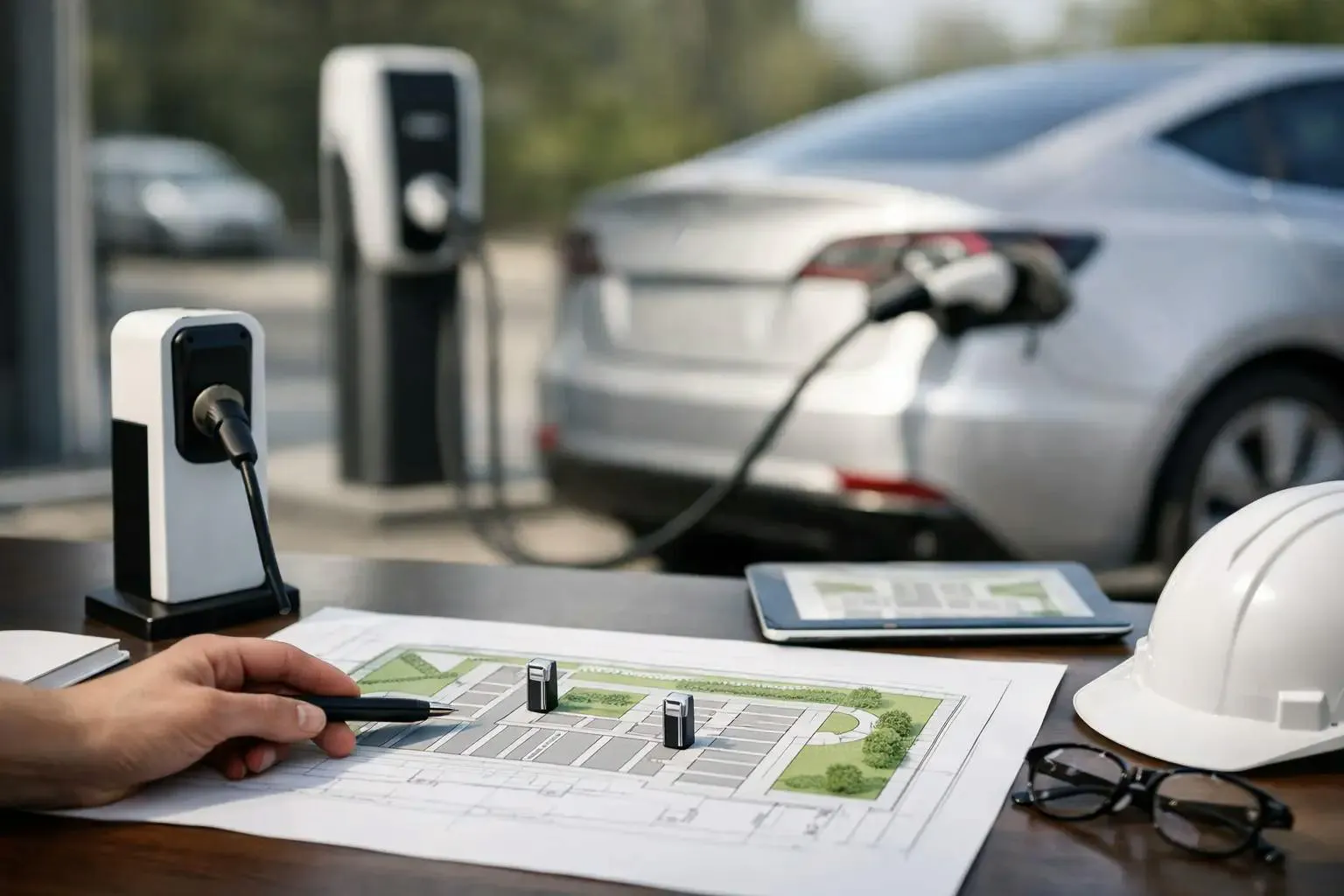
Start with how the vehicle is actually parked
The first step in how to plan EV charger placement is looking at real parking behaviour, not idealised parking. Some households always nose in. Others reverse into a garage because it gives better boot access. In a business car park, bays may be shared, rotated or used by visitors who have never charged on site before.
The charging port location on the vehicle matters more than many people expect. Some EVs charge from the front corner, others from the side or rear. If you are replacing one car with another in a few years, it is worth allowing for a charger position that can still serve different models without cable strain.
This is where a site inspection helps. Measuring the distance from the proposed charger location to the vehicle port sounds simple, but small details change the outcome. Garage shelving, pillars, roller doors and the swing of a car door all affect whether a charger feels convenient or awkward.
Think beyond the shortest cable run
A shorter cable run from the switchboard can reduce installation complexity and cost. That is a practical consideration, and a good electrician will always factor it in. But the cheapest wiring path is not always the best charger location.
If placing the charger closer to the switchboard creates a daily hassle, the savings can disappear in inconvenience. You do not want to drag a cable across a walkway, stretch it around a second car, or position it where it is constantly bumped by bikes, bins or garage storage.
The goal is to find the right balance between electrical efficiency and everyday use. Sometimes that means running a little more cabling to place the charger exactly where it should be. In other cases, the smarter move is to adjust parking layout or choose a charger with cable management that keeps everything neat and safe.
How to plan EV charger placement for safety
Safety should shape every placement decision. Chargers need to be installed in suitable locations, with proper clearances, secure mounting and protection from impact. They should also be positioned so cables do not create trip hazards or get pinched by doors and vehicles.
In a home garage, wall height matters. Too low, and the unit may be vulnerable to damage or awkward to use. Too high, and plugging in becomes less comfortable, especially for family members who charge the car regularly. Outdoor installations need extra thought around weather exposure, drainage and the durability of the equipment selected.
For apartment buildings, strata properties and commercial sites, safety also includes shared access. You want a charger that is easy for authorised users to reach without creating confusion for others using the space. If bollards, signage or access control are needed, they should be planned at the same time rather than treated as an afterthought.
Consider your switchboard and power supply early
One of the biggest mistakes in planning is choosing a charger location first and only then asking whether the existing electrical system can support it. A licensed electrician should assess your switchboard, available capacity and the best route for cabling before the final position is locked in.
Sometimes the ideal wall is straightforward because it sits near a suitable switchboard and has enough capacity available. Other times, the property may need a switchboard upgrade, circuit changes or load management to support EV charging safely. This is especially relevant in older homes around established North Shore suburbs, where existing electrical infrastructure may not have been designed with EV charging in mind.
For businesses, the question is often bigger than one charger. If there is any chance you will add more chargers later, placement should allow for future circuits, distribution upgrades and sensible expansion without reopening finished surfaces or disrupting operations twice.
Indoor or outdoor placement depends on the site
Many homeowners assume a garage installation is always the best option. Often it is, because the charger is protected and the cable stays out of the weather. But not every property has a garage that suits the vehicle, and not every garage has the wall space or switchboard access needed.
An outdoor installation can work very well when it is planned properly. Driveway charging, side access installations and carport placements are common across Sydney homes, particularly where garage space is used for storage or a second vehicle. The important thing is choosing equipment rated for the conditions and mounting it where it remains accessible without being overly exposed.
Commercial sites have similar trade-offs. Indoor basement parking can offer protection and controlled access, but ventilation, cable routing and tenancy arrangements may complicate the install. Outdoor bays can be easier to access for staff or customers, though they may require stronger physical protection and clearer site management.
How to plan EV charger placement for future needs
A charger should suit the way you live now, but it should not be planned only for today. If you are renovating, adding another vehicle, moving to a larger battery EV, or considering solar and battery integration later, the placement should support that future.
This does not always mean overbuilding. It means thinking ahead sensibly. A family home may only need one charger now, but if two EVs are likely within a few years, it is smart to consider whether the location leaves room for a second unit or load-sharing setup. For landlords and strata properties, future planning can also help avoid costly rework when tenant demand changes.
Businesses should be especially careful here. A charger placed well for one fleet vehicle may be poorly positioned for visitor parking or additional bays later. If your site may grow, charger placement should align with a broader parking and electrical plan rather than a quick one-off install.
Don’t ignore the user experience
Good charger placement is partly electrical and partly practical. The user experience matters. Can the driver park naturally and plug in without stretching? Is the charger visible enough to use easily but not placed where it looks intrusive? Can visitors or staff understand which bay is for charging and how to access it?
This is where a service-first approach really helps. The best electricians do not just install to a diagram. They ask how the space is used, who will be charging, whether children move through the area, and what will make the setup simple and safe over time.
At Bright Choice Electrical, that kind of planning matters because tidy, reliable workmanship starts before installation day. A charger should not look like an afterthought. It should feel like part of a well-considered electrical setup.
Common placement mistakes to avoid
Most charger placement issues come down to assumptions. People assume the car will always park the same way, that a cable will reach comfortably, or that any nearby wall will do. Once installed, those small assumptions become everyday annoyances.
Another common mistake is placing the charger where it blocks storage, interferes with garage movement or clashes with opening doors. In commercial settings, poor placement can lead to non-EV vehicles occupying the bay, charger cables crossing pedestrian paths, or users struggling to identify the correct charging spot.
There is also the temptation to hide the charger completely for aesthetic reasons. A neat finish matters, but hiding it too well can make charging awkward. The best outcome is usually a location that is discreet, accessible and easy to keep clean and protected.
Why an on-site assessment makes the difference
Photos and rough measurements are useful, but they rarely tell the whole story. The angle of the parking bay, the condition of the wall, the route back to the switchboard, and the obstacles inside the roof or wall cavity all influence what is possible.
That is why an on-site assessment is often the smartest first step when deciding how to plan EV charger placement. A qualified electrician can assess compliance, explain your options clearly and recommend a location that suits both the property and the way you use it.
For homeowners, that means fewer surprises and a cleaner result. For businesses, it means a charger layout that supports safety, uptime and future use rather than just ticking a box.
The right charger location should make charging feel easy, not like a workaround. If the placement is planned carefully from the start, the whole setup tends to work better, look better and last better too.
Need a Licensed Electrician?
Get a fast, obligation-free quote for your switchboard upgrade today.
Related Articles
Why Is My Power Bill So High? Common Reasons Sydney Households Are Paying More
Rising electricity bills have become a growing concern for households across Sydney. Every billing cycle, more families are noticing their energy bill creeping up, often without any major change in how they live. The frustration usually starts when the bill is higher than expected, and homeowners begin to wonder what’s driving the increase. Understanding why your power bill is so high isn’t just about saving a few dollars; it’s about taking back control of your household energy usage. From hidden appliances quietly draining power to inefficient systems running overtime, there are several common reasons your bill might be higher than usual. By learning what causes these issues, Sydney homeowners can make smarter choices that lead to lower costs and a more efficient home.
Bright Choice Team16 February 2026
Benefits of Transitioning From Overhead Lines to Underground Power Lines
Do you remember the storm in 2009 with ice melting down power lines, leaving thousands in Melbourne without electricity for days? The culprit, as usual, was a maze of fragile overhead lines. This scene is common around the world and brings into sharp focus a pressing question: should we continue relying on exposed transmission poles, or is it time to embrace the new gold standard—underground power lines? This article will guide you through the world of underground power, from daily realities to the financials, the life-changing advantages, and practical steps for homes and businesses to make the leap. If you want cleaner streets, safer communities, and a more reliable electricity supply, read on to discover exactly why so many Australian cities are moving from poles to perfection. Understanding the full process behind underground power, and how the benefits of underground power outshine traditional overhead networks, is key for homeowners, businesses, and community planners. This comprehensive guide explains not just why underground power lines are becoming the future, but how Bright Choice Electrical can facilitate your smooth transition, every step from first planning to flawless connection.
Bright Choice Team18 August 2026
How Much Does EV Charger Installation Cost?
Buying the EV is the easy part. The real question most homeowners ask next is how much does EV charger installation cost, and the honest answer is that it depends on your home, your switchboard, and the charger you want installed. For homes across Sydney’s North Shore and Northern Beaches, most installations sit somewhere between a straightforward job and a more involved electrical upgrade. A simple install in a modern home with a compliant switchboard can be quite reasonable. An older property with limited capacity, a long cable run, or the need for added protection can cost more. The key is getting a licensed electrician to assess the site properly so you know what you’re paying for and why.
Bright Choice Team18 August 2026